
Cheyenne County Mugshot Records
A booking photograph records appearance at intake. It does not prove guilt, show the final case outcome, or establish that the person remains in custody. Release does not automatically erase the underlying image. Still, an image must be linked to the right booking, agency, and date before it can help confirm identity.
Kansas open-record principles provide a starting point, but every photograph is not automatically available in every circumstance. Kansas Attorney General Opinion 87-25 discusses jail books, standard offense reports, and mug shots under the Kansas Open Records Act. Juvenile records, sealed or expunged matters, criminal-investigation material, medical information, and identities protected by law can require withholding or redaction.
A focused request is safer than a broad claim. Ask the custodian for the photograph tied to a named booking number or date. If the agency withholds it, ask for the specific legal basis and release of any segregable public portion. Never try to reconstruct a sealed or expunged record from old caches.
Cheyenne County Mugshot Channels
No one image source covers every Cheyenne County release. The county Sheriff’s site has no public roster photo. Sherman County shows images only on its current roster and only for people actually held there. KASPER has correctional photographs for its state population, while county-only bookings may never enter KDOC.
| Channel | Has a photo? | How to access |
|---|---|---|
| Cheyenne County Sheriff | No online gallery found | Request the specific booking photograph under KORA |
| Sherman County Jail | Yes, for its current roster | Use only after confirmation that Sherman County held the person |
| KASPER | Often, for the KDOC population | Search by KDOC number or match identity fields |
| KBI offender registry | May show a registry image | Applies only to people with a current registration duty |
| Kansas VINE | Interface fields vary | Use for county-jail status, not as the source of a certified image |
| News or third-party pages | Sometimes | Treat as a lead and return to the official custodian |
For a named person, the Cheyenne County release-record search helps establish the last custodian before a photo request is sent.
Cheyenne County Photo Custodians
The Cheyenne County Sheriff’s official site publishes no booking images, inmate roster, recent-release archive, or local mugshot gallery. That does not mean no image was taken. It means the person seeking a photo must ask where the subject was physically held and which agency created the booking record.
If an authoritative source identifies Sherman County as the custodian, its official current-inmate page may show a photograph, name, arrest date, charges, arresting agency, and bond while the person remains listed. The page has no historical release tab. Absence from it does not prove release, and geography alone does not prove that Sherman County ever held a Cheyenne County arrestee.
View Sherman County’s official current-inmate page only after custody is confirmed.
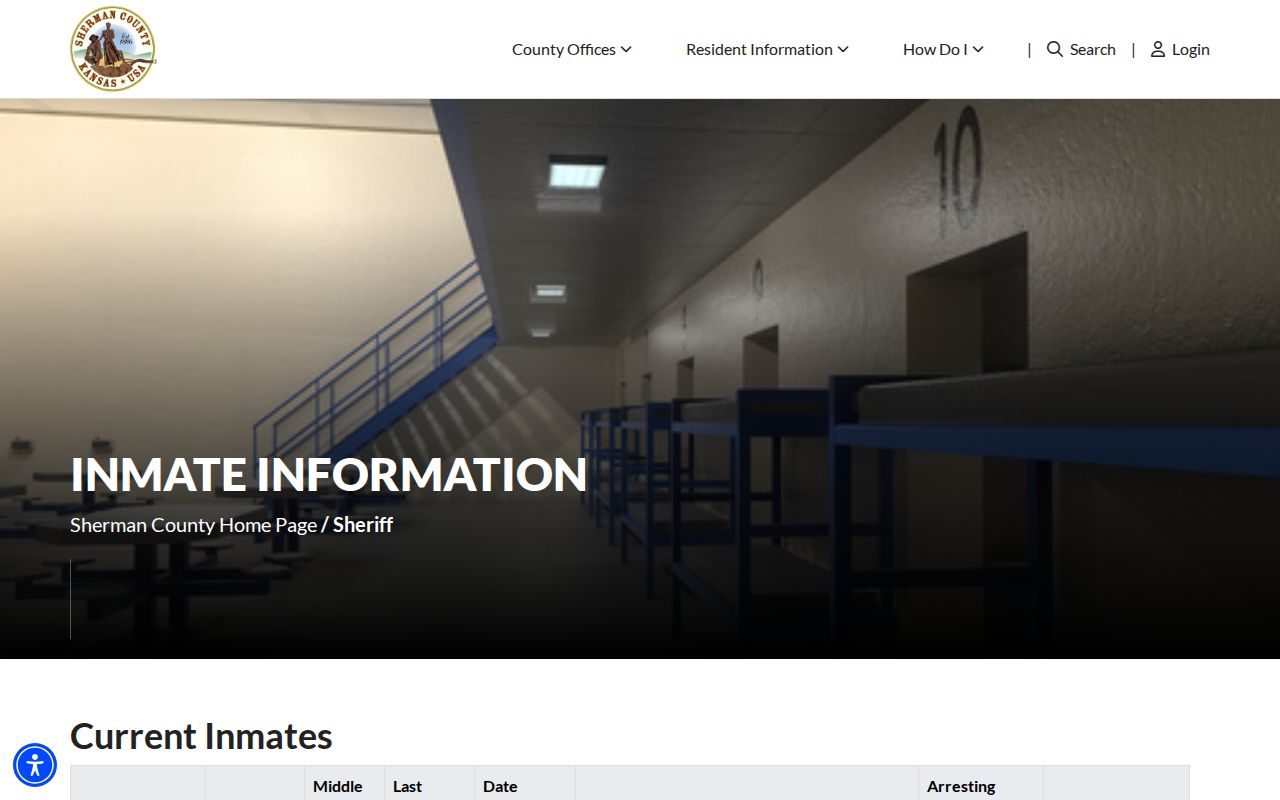
The screenshot demonstrates a current-custody photo source, not a Cheyenne County released-inmate archive. Its scope and date must stay attached to any use of the image.
Request Cheyenne County Booking Photos
Address the request to the record holder. The likely starting point is the Cheyenne County Sheriff’s Office at 212 E. Washington, P.O. Box 613, St. Francis, KS 67756-0613, telephone 785-332-8880. The current page publishes no dedicated Sheriff form or photo fee schedule. The county clerk’s page offers an open-records request form if staff directs the request through general county routing.
- Confirm the full booked name, approximate arrest date, and booking number or case number when known.
- Ask where the person was physically booked and held. If another agency created the image, redirect the photo request there.
- Request an electronic copy of the existing booking photograph tied to that booking. Do not ask the custodian to compile a gallery.
- Ask for an itemized fee estimate before costs are incurred and request redaction of exempt material instead of withholding the rest.
- Keep the agency response, booking reference, image date, and source together so the photograph is not detached from its context.
KORA permits reasonable fees and advance payment. Under K.S.A. 45-218, if immediate access is not granted, the custodian must explain the cause of delay within three business days. That is a response deadline, not a promise that production will be complete by then.
Review the Kansas Open Records Act policy that governs the request framework.
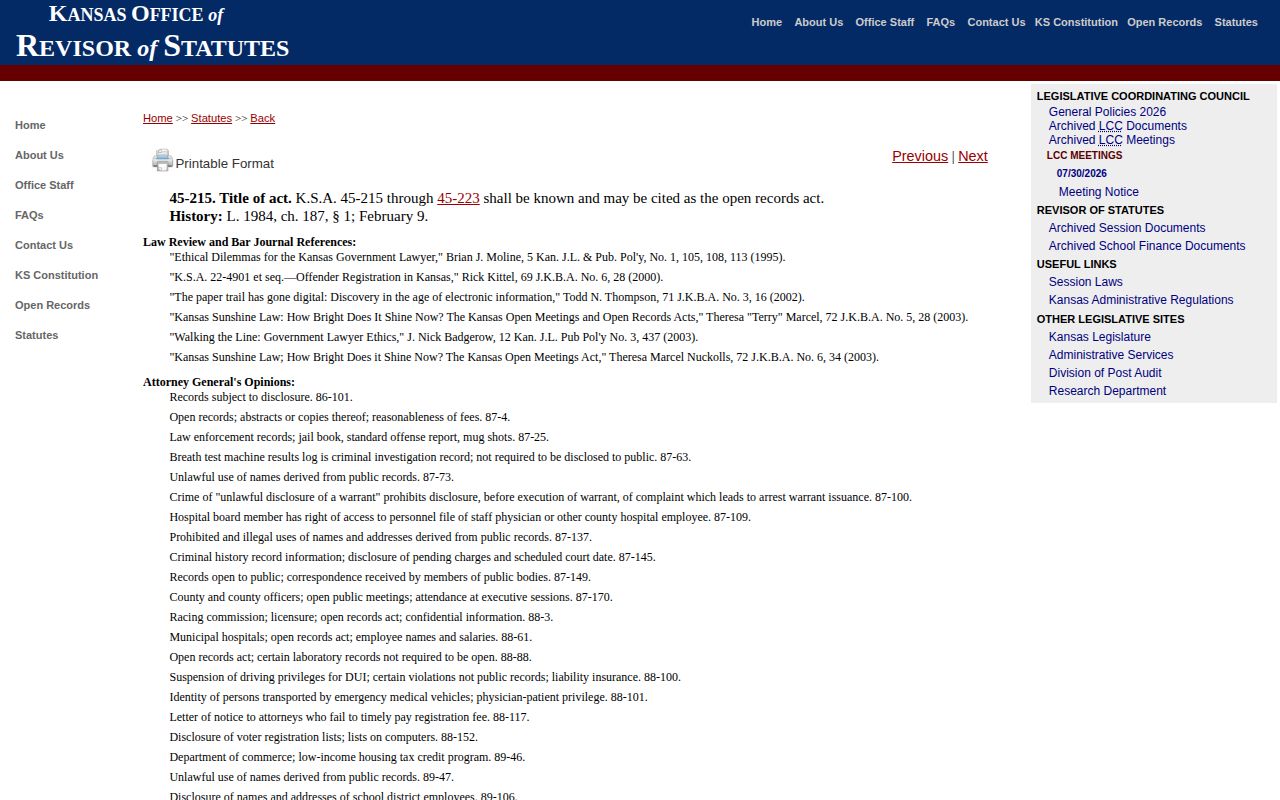
The law supports a precise request while preserving the agency’s duty to apply exemptions and redactions to the particular record.
Cheyenne County Mugshot App Limits
No official Cheyenne County Sheriff inmate or release mobile app was found. The county promotes CodeRED, but CodeRED sends emergency notifications. It is not an inmate lookup, photo archive, or release alert tool. Treating it as one would send readers to the wrong service.
VINEMobile and VINELink are the relevant statewide tools for custody searching and alerts from participating county jails. The Kansas Attorney General says Kansas VINE excludes prisoners housed in KDOC state facilities. It also does not replace the Sheriff’s certified booking photograph or release record.
Because interface fields can change, do not assume VINE will display a local photo. Use the service for its documented county-jail status and notification role. For a state prisoner’s correctional image, search KASPER. For a local booking image, request the actual custodian’s file.
The Cheyenne County 24-hour release list explains why the absent local feed must be replaced with phone, VINE, and record-request checks, not a photo gallery.
Cheyenne County KDOC Photographs
KASPER includes a photograph for many people sentenced to KDOC custody, including public records of people incarcerated, on post-incarceration supervision, or discharged. Match the KDOC number when possible. With a name search, compare birth date, conviction county, case number, physical description, and status before deciding that the image belongs to the subject.
A KDOC photograph is a state correctional image. It may not be the photograph taken after a local Cheyenne County arrest, and it should not be described that way. A county-only detainee who bonded out without a KDOC sentence may have no KASPER record at all.
The KBI Registered Offender Registry is narrower still. It applies only to people whom Kansas law requires to register. A registry photo can corroborate the identity and public registration record of a registrant, but its presence does not prove the release date. Absence supplies no answer for the general released population.
Cheyenne County Secondary Photo Sources
News reports, official press releases, and third-party pages can preserve an arrest image after an agency removes a live roster entry. Such an image is secondary evidence. It may come from an older event, omit a transfer or disposition, or even concern Cheyenne County in Nebraska rather than Kansas.
Use a secondary image only as a lead back to the official record. Check the publication date, photo credit, named agency, case number, and state. Do not link to commercial mugshot galleries, data brokers, or services that charge to remove an image. Paying a private publisher does not alter the Sheriff, court, or KDOC record.
A news photo should also not be used to infer guilt or current custody. Charges can change or be dismissed, and release can occur while a case remains pending. The court disposition and custody record answer different questions than the image.
Note: Search results for Cheyenne County, Nebraska are a known false match and must not be treated as Kansas records.
Cheyenne County Mugshot Expungement
Kansas expungement can restrict disclosure of connected arrest, conviction, diversion, and incarceration records. Under K.S.A. 21-6614, waiting periods generally run from satisfaction of the sentence or diversion, or from discharge from probation, community corrections, parole, postrelease supervision, conditional release, or a suspended sentence.
The statute generally uses three years for subsection (a) matters and five years for specified subsection (c) categories, with exclusions and special rules. The key date may therefore be final supervision discharge rather than the day a person left jail or prison. Eligibility is fact-specific and should not be promised from a photo or release date alone.
If a public KASPER or court record disappears, expungement is one possible reason. Reversal or executive clemency can also affect KDOC publication. Do not assume why a record is absent, and do not republish a cached copy to defeat a lawful restriction.
Cheyenne County Mugshot Removal
No official Kansas source reviewed established a broad commercial anti-pay-to-remove statute like those adopted in some states. That finding must not be turned into a claim that no other law applies. Privacy, defamation, copyright, consumer-protection, expungement, and record-specific restrictions can still matter.
For an official source, present an expungement or sealing order to the agency and ask about its current process. For a news publisher, use the publisher’s correction or removal policy without implying that the publisher must erase accurate archives. Commercial removal services are not endorsed.
The best record practice is restraint. Use an official image only to identify the correct custody record. Preserve the source and date, respect restricted matters, and avoid language that shames a person or implies that an old arrest photo describes present status.
When two images appear to conflict, compare the agency, booking date, and case rather than choosing the clearer photo. A later KDOC image and an earlier county intake image can both be authentic records of different custody events.
Keep that distinction in every caption and request.
Never detach the image from its source agency, booking event, and record date.