
Cheyenne County Release Date Meaning
KDOC calls its prospective public field “Anticipated Release Date.” That exact label matters. It is a calculation based on the sentence information and credits then available to the agency. It is not a Cheyenne County jail appointment, a guarantee of release, or proof that all other holds have cleared.
The actual release date records what happened after processing. It may differ because a court amended the sentence, jail credit changed, the person earned or lost credit, a Board decision occurred, or another agency asserted a hold. A movement to parole or postrelease supervision is release from prison, but not final discharge from the sentence.
A pretrial detainee is different. Until bond is posted or a judge issues an order, no fixed release date may exist. The court docket can show legal authority, while the Sheriff or actual holding jail supplies the physical exit time. If Cheyenne County transferred the person to another custodian, the county exit date is a transfer date, not community release.
Find Cheyenne County Projected Dates
The search route turns on the sentence. For a Kansas state prisoner, use KASPER. For a local jail sentence, ask the Cheyenne County Sheriff where the person is held and obtain the district court’s journal entry and jail-credit order. For federal sentences, the BOP locator is separate from both systems.
- Identify the custodian. Ask the Sheriff for the last custody event when the holding location is not clear.
- For KDOC, search by KDOC number when possible. Otherwise match the name, birth date, photograph, conviction county, case number, and physical description.
- Read “Anticipated Release Date” beside current location, movements, and supervision status. Note the date and time of the lookup.
- For a county sentence, obtain the filed journal entry and jail-credit finding, then ask the actual jail for the release calculation.
- If dates conflict, call the KDOC Sentence Computation Unit at 785-296-3317 with the KDOC number, or ask the jail which existing public field explains its calculation.
The Cheyenne County release-record path can help identify the actual custodian before a date search begins. A person who bonded out of a county-only case may never appear in KASPER because that system covers people sentenced to KDOC custody.
Cheyenne County KASPER Date Fields
KASPER includes Kansas prisoners, people on post-incarceration supervision, and discharged people sentenced to the Secretary of Corrections since 1980, subject to stated exclusions and removals. Its public record can show a KDOC number, photograph, convictions, case and county, current location, movements, supervision office and level, disciplinary findings, and the anticipated date.
KDOC says KASPER updates daily except weekends. A recent court action, credit change, movement, or release may therefore lag. Conviction County “Cheyenne” connects the state record to a case. It does not prove that the person is housed in Cheyenne County or will return there.
Read KDOC’s official explanation of KASPER scope and date fields.

The official locating material supports the date search, but identity matching and later confirmation remain essential because KASPER itself warns that information can change.
| Field | Use | Limit |
|---|---|---|
| KDOC number | Best unique search key | Applies only to the KDOC population |
| Anticipated Release Date | Current prospective date | Can change with credits and sentence computation |
| Movement and location | Shows state custody transitions | Updates can lag |
| Supervision level | Distinguishes inmate, parole, postrelease, or discharge states | Community status is not always final discharge |
Cheyenne County Good-Time Rules
For guideline crimes, K.S.A. 21-6821 governs the KDOC good-time and program-credit framework. Good time is credit a person may earn and retain under law and agency rules. It is not an automatic promise. The statute generally limits subtractable good time to 15 percent of the prison portion for offenses committed on or after July 1, 1993.
The law provides a 20-percent limit for listed lower-severity categories under specific offense-date rules. This is why “serve about 85 percent” can describe some Kansas guideline sentences but cannot serve as a universal formula. An eligible 20-percent category, older sentence, off-grid crime, county jail term, or special statute may produce a different result.
The same statute permits program credit for qualifying residents serving specified lower-severity offenses who complete approved education, vocational, treatment, or risk-reduction programs. Current law caps retained program credit at 120 days and excludes credit for completion of a sex-offender treatment program. Not every prisoner qualifies, and the credit is not an extra automatic subtraction for all KDOC sentences.
View the current Kansas good-time and program-credit statute.
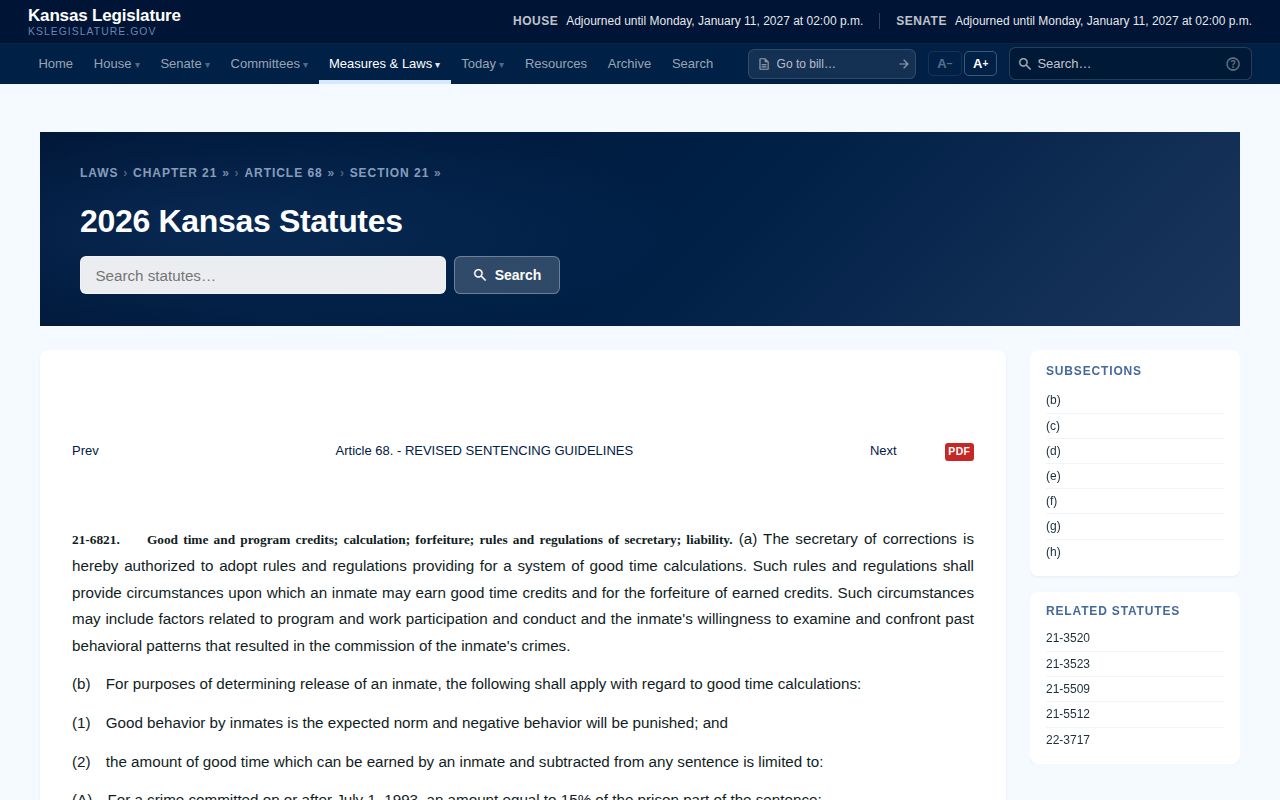
The statutory text shows why a named person’s date must come from KDOC’s operative computation instead of a broad percentage applied outside its legal context.
Note: Credits can affect the prison portion or, in specified cases, shift time to supervision without erasing the full sentence.
Cheyenne County Older Sentences
Crimes committed before July 1, 1993 may fall under the older indeterminate framework in K.S.A. 22-3725. Its good-time table generally permits one-half of a qualifying minimum or maximum term for sentences of two years or more, earned under applicable rules. The credits relate to parole eligibility or conditional release.
Eligibility is not a grant. Parole eligibility means the Prisoner Review Board may consider release. Conditional release is a statutory date based on the maximum term less retained good time. A hearing calendar or public-comment list does not prove the Board granted parole or that the person left on the listed date.
Review the pre-1993 Kansas good-time statute.
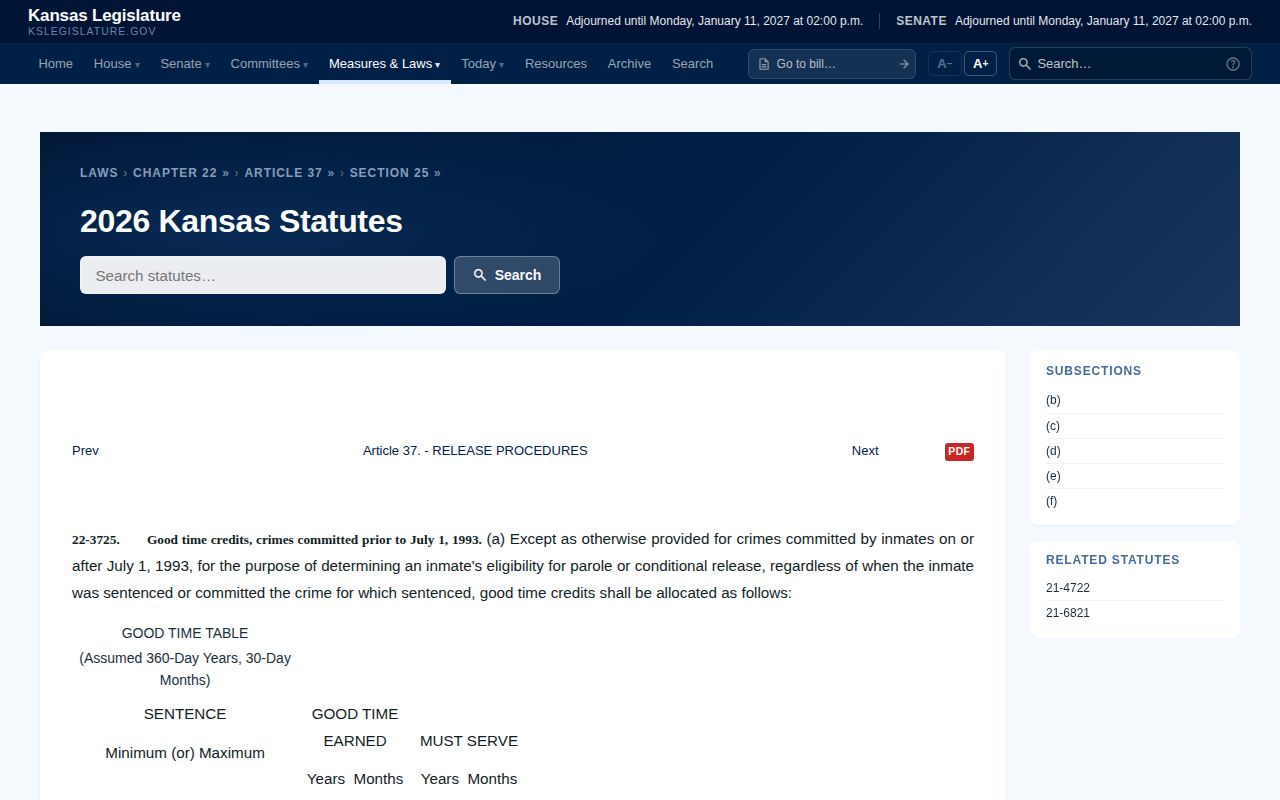
The older framework is another reason not to force every Cheyenne County projected release date into a modern 15-percent shorthand.
Cheyenne County Jail Calculations
KDOC credit rules do not automatically govern a Cheyenne County jail sentence. The district court’s journal entry, jail-credit order, sentence structure, and any lawful local computation control. The Sheriff publishes no county good-time policy, weekend-release rule, holiday rule, or public calculator. Those missing policies cannot be borrowed from another Kansas county.
Ask for the existing calculation rather than asking staff to create a legal opinion. A focused inquiry identifies the booked person, case number, sentence date, jail credit, and the date field being questioned. If another county physically holds the person, direct the calculation question to that custodian and use Cheyenne County’s record only to document the transfer.
Cheyenne County Date Changes
A valid projection may later move. The cause should be traced to the agency or court record rather than guessed from an old screenshot. Each factor affects a different part of the custody chain.
| Factor | Possible effect | Best record |
|---|---|---|
| Jail credit correction | Moves the computed prison or jail term | Journal entry and KDOC computation |
| Earned or forfeited credit | Moves an anticipated state date | KDOC sentence record |
| Consecutive or new sentence | Adds or restructures custody time | Court orders and KDOC calculation |
| Detainer or warrant | Can cause transfer or continued custody | Sending and receiving agency records |
| Parole action or revocation | Changes eligibility, release, or return to custody | Board action, docket, and KASPER |
| Amended court order | Corrects the sentence basis | Filed journal entry |
A detainer is a request or legal basis for another agency to assume or maintain custody. If the Sheriff records “release to another agency,” obtain the destination. The date only ends Cheyenne County custody. It does not show that the person entered the community.
Sentence structure also matters. Concurrent terms run at the same time to the extent the court orders, while consecutive terms run one after another. A journal entry, later correction, or separate case can change which structure KDOC must apply. Jail credit is time the court recognizes toward a sentence, and an amended credit figure can shift the calculation without any new disciplinary event.
Parole eligibility is another source of confusion. It is the point when an eligible person may be considered, not a promised release date. The Prisoner Review Board may grant parole, continue the matter, or pass the person for a stated interval. For determinate sentences, postrelease supervision usually follows the prison portion by operation of the sentence rather than through the older parole-suitability process.
Confirm Cheyenne County Release Dates
Final confirmation comes from the later movement, discharge, or release record. Recheck KASPER after the prospective date for a state prisoner. A move to parole or postrelease supervision supports physical release from prison but also shows continuing legal supervision. “Discharged” means the KDOC obligation has ended.
Kansas VINE can provide county-jail custody alerts, but the Attorney General says it excludes KDOC prisoners. The Cheyenne County VINELink check is therefore useful only when the actual custodian participates as a county jail. KDOC has a separate victim-notification process for its own population.
For formal proof, request the Sheriff or actual jail’s release record, the KDOC discharge or movement record, or the filed court order. Preserve the exact label and lookup date. If sources conflict, contact the custodian and describe the conflict as unresolved until an authoritative record explains it.
The court file and custody file answer related but different questions. A bond, sentencing, or release order states the legal authority. The jail movement states when the person physically left and whether another agency received them. KASPER supplies the state correctional status. Use all three when a precise sequence matters.
A federal prisoner follows a separate path. The BOP Inmate Locator can retain a federal release date, but a displayed release does not rule out later state, local, immigration, or court supervision. Federal pretrial custody may instead be administered by the U.S. Marshals, which has no comparable public historical locator. The federal docket and identified custodian are then the better sources.
Always record when the dynamic search was checked and preserve its exact wording.
If the anticipated date passes without a public movement, do not assume the person left custody. Recheck KASPER after its working-day update cycle, review the court docket for a new order, and ask Sentence Computation about the public field. A disciplinary action, new case, warrant, revocation, detainer, or corrected sentence structure can alter the sequence. Formal confirmation comes from the later KDOC movement or discharge record, not from the old projection standing alone.