
Cheyenne County Three-Day Release Window
The official Cheyenne County Sheriff page has no current-roster table, released tab, booking archive, or 72-hour view. It also gives no automated update cycle or retention period. A three-day window must therefore be built from an inquiry bounded by dates, not from a public rolling feed.
Call 785-332-8880 and identify the person, approximate arrest, and dates being checked. Ask where the person was physically held. Then request the last custody event, its time, its authority, and the destination. This wording prevents “not in custody here” from being mistaken for proof that the person entered the community.
The archived official Sheriff contact page documents the local contact route without a rolling 72-hour release view.
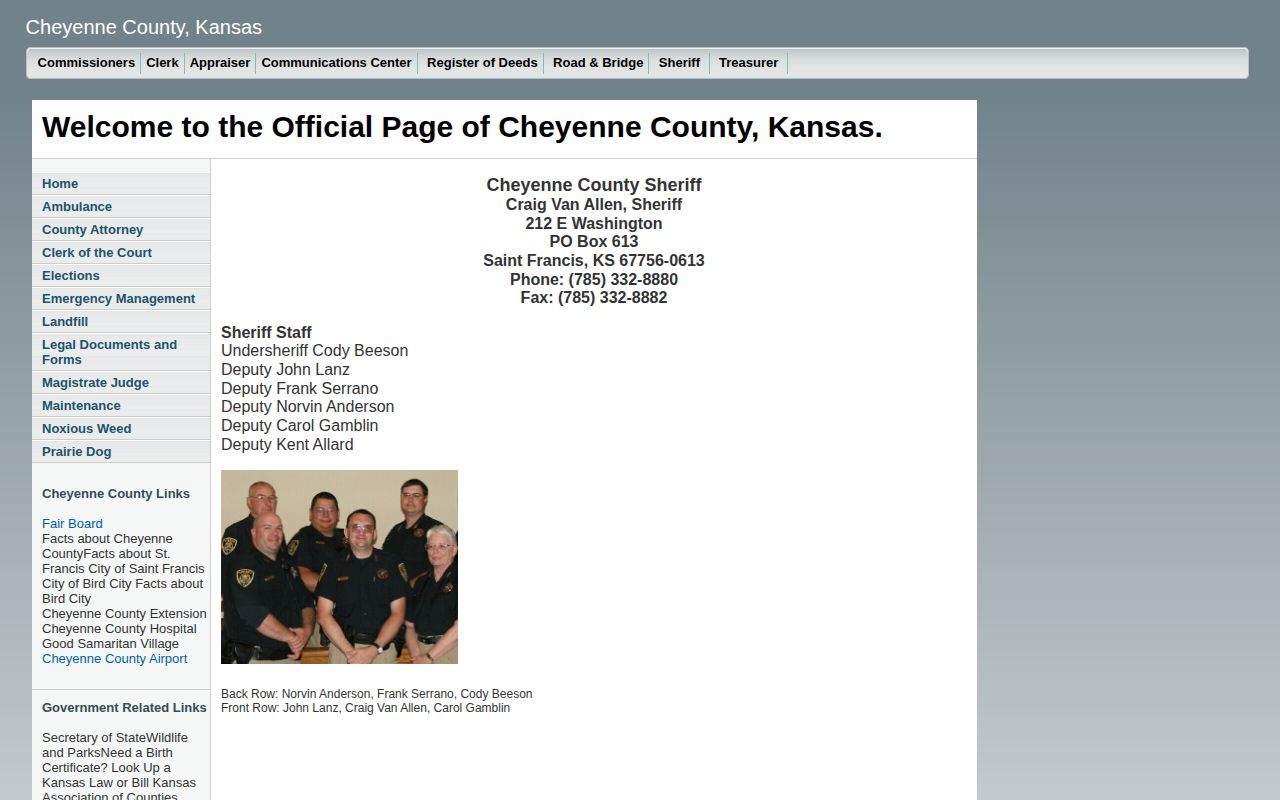
The screenshot reinforces why a dated phone inquiry and records request replace a nonexistent online three-day list.
Check Cheyenne County Releases Over Three Days
Use the date span as a request limit. A three-day inquiry is still person-specific because the Sheriff does not publish a browsable list. Keep the county and state clear. Search engines often surface Cheyenne County, Nebraska, which has a different roster and must not be used for Kansas records.
- Set the beginning and end of the 72-hour period, including local dates and approximate times.
- Gather the full name, date of birth, arresting agency, booking date, and case number when known.
- Ask the Cheyenne County Sheriff where the person was housed and what the last custody event was.
- Use Kansas VINE if the participating county-jail system has a matching record or notification event.
- Review the district-court docket for a bond, dismissal, sentencing, probation, or revocation order.
- Request the existing booking and release record when an exact exit time or receiving agency is needed.
The Cheyenne County 24-hour release process is better for a same-day check. It uses the same verified channels with a tighter time range.
Cheyenne County Three-Day Record Fields
No online Cheyenne County table exposes fields for this window. These items belong in a focused request to the custodian. They connect an exit to the right intake and show whether custody truly ended.
| Requested field | Why it matters |
|---|---|
| Full booked name and booking number | Separates similar names and links the intake to its exit. |
| Booking date and time | Fixes the custody episode inside the three-day review. |
| Release date and time | Shows when the named custodian’s control ended. |
| Release authority or type | May identify bond, court order, time served, or completion. |
| Destination or receiving agency | Distinguishes community release from continued custody. |
| Arresting and holding agencies | Shows where related records should be requested. |
Request an existing record rather than asking staff to compile a new list. A booking photograph is a separate field, subject to lawful redaction or withholding. The local image and a later KDOC correctional photograph are not the same record.
Cheyenne County Weekend Release Checks
A wider range helps when the arrest or possible exit crossed midnight, a weekend, or a holiday. It does not establish how Cheyenne County schedules releases. No official local source reports a weekend-processing rule, holiday cadence, set exit time, physical exit point, or property-return procedure. Those details must not be borrowed from another Kansas jail.
Ask for the event time recorded in the jail-management record. Compare it with the filed court order when one exists. An order may authorize release before staff complete operational steps. Conversely, a county exit timestamp may mark transfer to another agency instead of release to the community.
The Cheyenne County released-inmate lookup provides the wider source chain for a named person, including state, court, federal, and immigration routes.
Obtain Cheyenne County Release Proof
Send a narrow Kansas Open Records Act request to the Sheriff or records custodian at 212 E. Washington, P.O. Box 613, St. Francis, KS 67756-0613. Identify the person and the three-day range. Ask for an electronic copy of the existing booking and release record, including the exit type and destination. The county publishes no dedicated Sheriff form or fee schedule.
Ask for an itemized estimate before costs exceed a chosen amount. Kansas law allows reasonable fees and advance payment. If access is not immediate, the custodian must give a detailed reason for delay within three business days. The rule governs the response, not a universal production date. If another county held the person, redirect the main request there and ask Cheyenne County for its transfer record.
A public court document can support the legal reason. It rarely replaces the custodian’s exit timestamp. Preserve both records if the distinction between an order and physical release matters.
Cheyenne County Roster Search Pitfalls
The lack of a local archive is the key data quirk. Do not substitute Sherman County’s current inmate page unless an authoritative source first identifies Sherman County as custodian. That page shows current inmates, photographs, arrest dates, charges, arresting agency, and bond. It offers no historical or recent-release tab.
Do not use the Nebraska “New Inmate Roster” or its PDF files. They belong to another state. A result should match Cheyenne County, Kansas, the correct person, the actual custodian, and the relevant date span. A failed search should be reported as unconfirmed, not converted into a definite release.
Note: Keep the exact displayed status and the time checked, because dynamic custody data can change.
Cheyenne County Release Source Routes
Kansas VINE covers county-jail status and notifications, but it expressly excludes KDOC state-prison residents. A county-only defendant who bonded out may never appear in the state corrections database. A person transferred into a Kansas prison should be checked in KASPER for location, movement, supervision, or discharge status.
- County release
- Confirm through the custodian’s exit record and the court order.
- KDOC transfer or release
- Use KASPER and KDOC records after a state sentence.
- Federal custody
- Use the federal docket, USMS route, or BOP locator.
- ICE transfer
- Use the ICE locator or ERO after the receiver is identified.
These routes cannot be merged into one 72-hour table. Each agency records the end of its own custody. Follow the destination field until the chain reaches community release or a confirmed continuing custodian.
Cheyenne County Three-Day Court Review
The statewide Kansas District Court Public Access Portal can help explain an event inside the 72-hour span. Search by exact case number when possible. With a name, narrow results to Cheyenne District Court, criminal cases, and relevant dates. Read the filed order. A charge entry alone does not show whether bond was posted, a case was dismissed, a sentence was imposed, or a hold remained.
Orders and jail events answer different questions. A bond or release order supplies legal authority. The custodian’s release entry supplies the operational time and destination. There can be a gap between them. If a public image is missing, the courthouse clerk may provide the filed document. Sealed and expunged material is not public, so absence must be reported without trying to reconstruct it.
A probation order can mean the person is in the community under court supervision. A state-prison release can instead lead to parole or postrelease supervision under KDOC. Neither status is the same as final discharge. Read the responsible agency and the current status before describing the outcome.
Verify Cheyenne County Release Evidence
The strongest source for the precise local exit is the booking and release record held by the actual jail custodian. A court order is strongest for the legal authority. Kansas VINE is useful for quick notification but remains a derivative feed. KASPER is the public starting point for state custody, while a formal KDOC record is stronger proof of state release or discharge.
Record when each dynamic source was checked. Keep the displayed wording. “Anticipated Release Date” is prospective. “Parole” or “postrelease supervision” means prison housing ended while correctional supervision continued. “Discharged” means the full KDOC sentence obligation ended. A county “release” to another agency only marks the end of county control.
If two sources conflict, call the custodian and ask which event each date represents. Do not average dates or select one without explanation. A precise three-day review can end with an unresolved result, but it should not end with an unsupported conclusion.
Keep the beginning and end of the three-day range explicit. Ask whether each event was a community release, transfer, or another agency pickup. Match the booking number, case, and custodian before joining records from different systems. If the Sheriff names another holding jail, request that jail’s intake and exit event along with Cheyenne County’s transfer entry. This two-agency check prevents a local departure from being mistaken for freedom.
Public Record Search
Sponsored Results